Catalog of Asian Women
Extensive Online Catalog of tempting Asian Ladies. Find Asian Love

April 29, 2009

Solo Traditional Market

Traditonal market is a reflection of a social life within a specific society. The market is the source of culture where the expression of social behavior and social values can be found. Unlike modern market, there is an intensity of interaction built in the traditional market. As the source of culture, the traditional market does not exist as a space to fulfill daily needs only, but it is becoming a space to express the art and culture of its society as well.
The traditional market therefore, has an importance role to built the strategy insight in order to envision the national strategy in reaching a nation that still bases on its roots.


Pasar Legi
Pasar Legi was built at the era of Mangkunegoro I (Sambar Nyawa Prince). Located on Jl. Sutan Syahrir, under the district of Stabelan, Banjarsari, Surakarta, the market has 16.1640m2 wide. Pasar Legi is the biggest market of agricultural products in Solo. The products come from local towns around Solo or other towns like Brebes, Temanggung, Tasikmalaya, Sidoarjo, Malang, and more. The market is open from early in the morning up to the evening.
In 2008 the government renovated some parts of the market building, which were fish area and coconut area. The renovation is in progress. The next renovation will be for the front part that faces to west side.


Pasar Gede Harjonagoro
Pasar Gedhe Hardjonegoro is stated on Jl. Urip Sumoharjo, under district of Sudiroprajan, Jebres, Surakarta was built by Sinuhun Pakoe Boewana in 1930. Designed by Thomas Karsten, an architect from Dutch, the market has a combination between European and traditional styles. In 2000, the market was on fire. It was then renovated without changing its original style.
The market was the first market that used sell and rent systems for its kiosks and built in levels in Indonesia.


Pasar Hardjodaksino
Pasar Hadjodaksino located on Jl. Yos Sudarso, under the district of Danukusuman, Serengan, Surakarta, the market was built on 7.688m2 area and declarated officially on 16 June 1987. At first, the market was known as Pasar Gemblegan. It was named after the location which is Gemblegan, near the Gemblegan bus station. It functioned as the dropped down place of the products that would go to Pasar Dawung and Pasar Gading.
In 2006 the government built the new kiosks at the front part of the market. Pasar 
Harjodaksino does not only provide daily needs, but it also provides wedding complimentary.


Pasar Kembang
Pasar Kembang is located on Jl. Dr. Radjiman, under the district of Sriwedari, Laweyan, Surakarta. It built upon 1.409m2 area. The market was named after its products, which are flower or kembang in 
bahasa. It provides mainly flower for funeral and the funeral complimentary. At first, the market area was a garden. In 1963 there were merchants who sold flowers at the northern side of the garden. As the merchants grew even more in its progress, the market, titled pasar kembang, was built in 1970. In 2006, pasar kembang renovated the building.


Pasar Nusukan
Pasar Nusukan is located on Jl. Kapten Piere Tendean, under the district of Nusukan, Banjarsari, Surakarta. It was built in 1958. It has been through some renovations. In 1986, there was a change for its width due to the land liberation of Nusukan district office and cinema building by the government.
In 2004, the market was on fire. It was then rebuilt in 2006. The government also allocated capital to subsidize the merchants of the market in that year. Pasar Nusukan provides various daily needs like foods and cloth. The activities begin early in the morning up to the evening. The vegetables merchants come from other local towns around Solo, like Boyolali, Sragen, Purwodadi, and Karanganyar.


Pasar Kadipolo
Pasar Kadipolo located on Jl. Dr. Radjiman, under the district of Panularan, Laweyan, Surakarta upon 1.500m2 area. The market was specified as a market that provided household items made of metal, like metal pales, metal rice-boiler or dandang, stove, etc. In 1989, the market was moved to Pasar Kabangan because the previous area would be used as a receiving-station for the Pasar Singosaren merchants. Pasar Singosaren it self, at that time, were going to be built as a semi-modern market by the government. Now, pasar kadipolo does not only provides metal household items. It also provides many kinds of daily needs in its progress.


Pasar Klithikan Notoharjo
Pasar Notoharjo was built in 2006 by the government. It is located on Semanggi, Pasar Kliwon, Surakarta and built upon 1.800 m2 area. The total of the merchants in the market are 909. They were used to sell their products around Taman Monumen 45 Banjarsari before Pasar Notoharjo was built. The area was known as Pasar Klithikan and the products offered were second hand things, like electronics, cloth, handphones, spare parts, and many others.
Pasar Notoharjo is very unique. The visitors can find second hand things which have been creatively modified by the merchants to make the things work well again.


Pasar Mojosongo
Pasar Mojosongo is located on Jl. Brigjen Katamso, under the district of Mojosongo, Jebres, Surakarta. It was built upon 1.120 m2 area in 1976. After some renovations in 2007, the market was renovated again by using the government.
Pasar Mojosongo provides daily needs. Most of the merchants come from the western side of Karanganyar.


Pasar Sidodadi
Pasar Sidodadi is located on Jl. Slamet Riyadi, under the district of Karangasem, Laweyan, Surakarta. The market has no specification on its products as it provides the variety of daily needs. The market was rebuilt in 2007 after the land liberation of Kleco burying ground.
»»  READMORE...

April 3, 2009

Flight Schedule


»»  READMORE...

April 1, 2009

Mangkunegaran Traditional Art


Solo’s Puro Mangkunegara palace celebrates over two centuries of existence with a royal bash that befits its regal stature.

The city of Surakarta, or Solo, in Central Java is one of Indonesia’s most
famous royal cities.

There are two major palaces– the venerable Susuhunan, home to 
the Pakubuwono royal family, and the less daunting Puro Mangkunegara.
Much of Solo’s indigenous population swears allegiance to one royal
family or the other.

November 2007 saw the 250th anniversary of the founding of the Puro
Mangkunegara. The occasion was celebrated with a colossal dance performance – Adeging
Puro Mangkunegara – in the palace’s main square; a gala charity dinner was attended by dignitaries and palaces groupies from across Asia.

Solo is famous for the beauty of its women, the ‘fairest’ in the land. The city is the beating heart of the Javanese traditional beauty industry– the Martha Tilaar Cosmetics chain is one example. Trends in traditional Javanese dress and hairstyles have generally started in Solo.

The ‘helmet-head’ coif of the wives of the ruling elite during the Soeharto era, for example, was derived from the strict Kabuki-like coif of the palace ladies of Solo (rumour had it that those who adopted this coif had to sleep standing up). The late Madame Soeharto, a great promoter of traditional Javanese culture, was a member of the Puro Mangkunegara family.

Over the past few decades the Puro Mangkunegara has attracted many patrons form Jakarta, not the least of whom being batik impresario Iwan Tirta, and Indonesia’s flamboyant former Tourism and Culture Minister Bapak Joop Ave. The rival palace, the Susuhunan, also know as the Keraton Solo, has its shakers and movers too, including the cultural czar and batik maestro KPT Harjonogoro (Go Tik Swan), curator of the Keraton museum (founded in 1890) during the years 1969-1999. Over the past f ew decades, as maintenance expenses have climbed, a spate of Jakartan generals and ministers have helped prop up the vast palaces with generous donations.


The Puro Mangkunegara has always attracted a younger more progressive crowd – the palace being less ‘constrained’ by ancient ritual – and the gala on 11th November 2007 was a celebration of the palace’s 250 years as a bastion of Javanese culture, beauty and the arts.
At the beginning of the evening I found Iwan Tirta in the rotunda-like
palace family’s reception pavilion, helping the palace ladies with their jewellery. GRA Roosati, the eldest daughter of Mangkunegaran VIII, who for years managed the Iwan Tirta boutique in Jakarta, was fielding last minute calls from the Jakarta social set. A bouquet of young princesses in pink party frocks had been parked in a possé at one end of the long white marble verandah. Javanese princesses and princes jostled for jewels.

Assorted royals from Johore and Kedah in Malaysia, and Karangasem in Bali milled about. Outside young dancers were putting the finishing touches to their costumes and make-up.

The palace’s main pavilion, the vast pendopo agung, had been converted for the evening into a Versailles-like banquet hall, with sensational flowers by Darmasto. Grandstands were set up to the North and South, along the pavilion’s edge, for the less well-heeled.

The royal family, looking immaculate, processed into the hall at seven and took their place at the central table. A Solonese dinner – part Javanese, part Dutch – was served by the palace staff at 8 p.m.

A symphony orchestra struck up across the field and the giant TV screens flickered into action. Tenors crooned as Jakarta beauties swept in late, stitched into figure-hugging sarong-k.

Amongst the guests I spotted Hans and Cynthia Hoefer, founders of Hoefer Media, from Singapore; Bali-based architect-to-the-stars Cheong Yu Kuan in a natty batik shirt; legendary Solonese beauty Yani Arifin in a cherry red chemise; Jakarta socialite Tango dancer Titiek Prabowo, third daughter of former President Soeharto, and, drooping gorgeous jewels, the glamorous Miranda Gultom, Deputy Chairman of Bank Indonesia (the central bank).

The ‘kolosal’ dance – featuring a garrison of horses, a brace of elephants, 500 dancers, a choir, a gamelan – was magnificently staged. The two hour spectacle told of the history of the palace’s founding, by Raden Mas Said, in 1757.

The dance performance climaxed with twelve bedoyo ballerinas, ushered by a pair of elephants, processing, solemnly, towards the centre of the pendopo agung. The bedoyo ‘dance of the princesses’ is the prerogative of only the royal palaces of Central Java and it always a treat to
witness the dream-like performance, on a big occasion, in a fully-dressed palace pavilion.

The dancing – choreographed by Putri’s brother, Gusti Heru and Daryono S. Kar – was mesmerizing. One sensed the influence of the great Solonese choreographer Sardono W. Kusumo, the dance guru famous in Bali for his Teges village Ketjak, which was first performed in Paris in the 1970s. The costumes, by GPH Herwasto Kusumo and M. Ng. Edi Sartono, were magnificent.

One scene in the ballet in particular–the three mystical dancers in the gold fountain (a present from Napoleon Bonaparte) with elephants rampant – will no doubt inspire a generation of butter statues and water features.
»»  READMORE...

Shopping Centers

Batik. You can buy anything made with batik in Solo. The fabrics range from silk to normal cotton. The ones made by hand (batik tulis) is of course more expensive than the ones made using the 'stamp' (batik cap). Beware though that most of batik will lose some color during first few washes -- washing with similar color is highly recommended.
  • Danar Hadi, Jl Dr Rajiman 164, Solo 57111. Tel.: (62)(271) 644126.
  • Keris, Desa Cemani Selatan Laweyan, Solo 57167. Tel.: (62)(271) 721217.
  • Semar, Jl Laksda Adisucipto 101, Solo 57144. Tel.: (62)(271) 722937
  • Kampung Batik Laweyan, Jl. Dr. Rajiman Laweyan.
  • Kampung Batik Kauman, Nearby Kraton Kasunanan. The batik products of Kauman village are made from natural silk and weaving silk materials, and premmisima cotton.
  • Pasar Klewer, a traditional market for textile, mostly batik. Located off the west gate of Keraton's North Square. As in any other traditional markets in Indonesia, you will have to bargain.
Mall & Shopping Centers
  • Solo Square, Jalan Slamet Riyadi No 451.
  • Solo Grand Mall, Jalan Slamet Riyadi No. 313
  • Ciputra Sun, Jalan Ronggowarsito. (Proposed)
  • Singosaren Plaza, Jalan Gatot Subroto
  • Megaland, Jalan Slamet Riyadi
  • Luwes Mall, Jalan Veteran
  • Ratu Luwes, Jalan S. Parman
  • Sami Luwes, Jalan Honggowongso
  • Gading Luwes, Jalan Veteran
  • Batik Semar, Jalan Laksda. Adi Sucipto 101 Surakarta
  • Batik Semar (Bale Sattwika), Jalan Raden Mas Said 148 Surakarta
  • Batik Semar (Pasar Klewer),Los Baru no 4-5 Pasar Klewer
  • Discount Outlet(PGS), Jalan Mayor Kusmanto Surakarta
»»  READMORE...

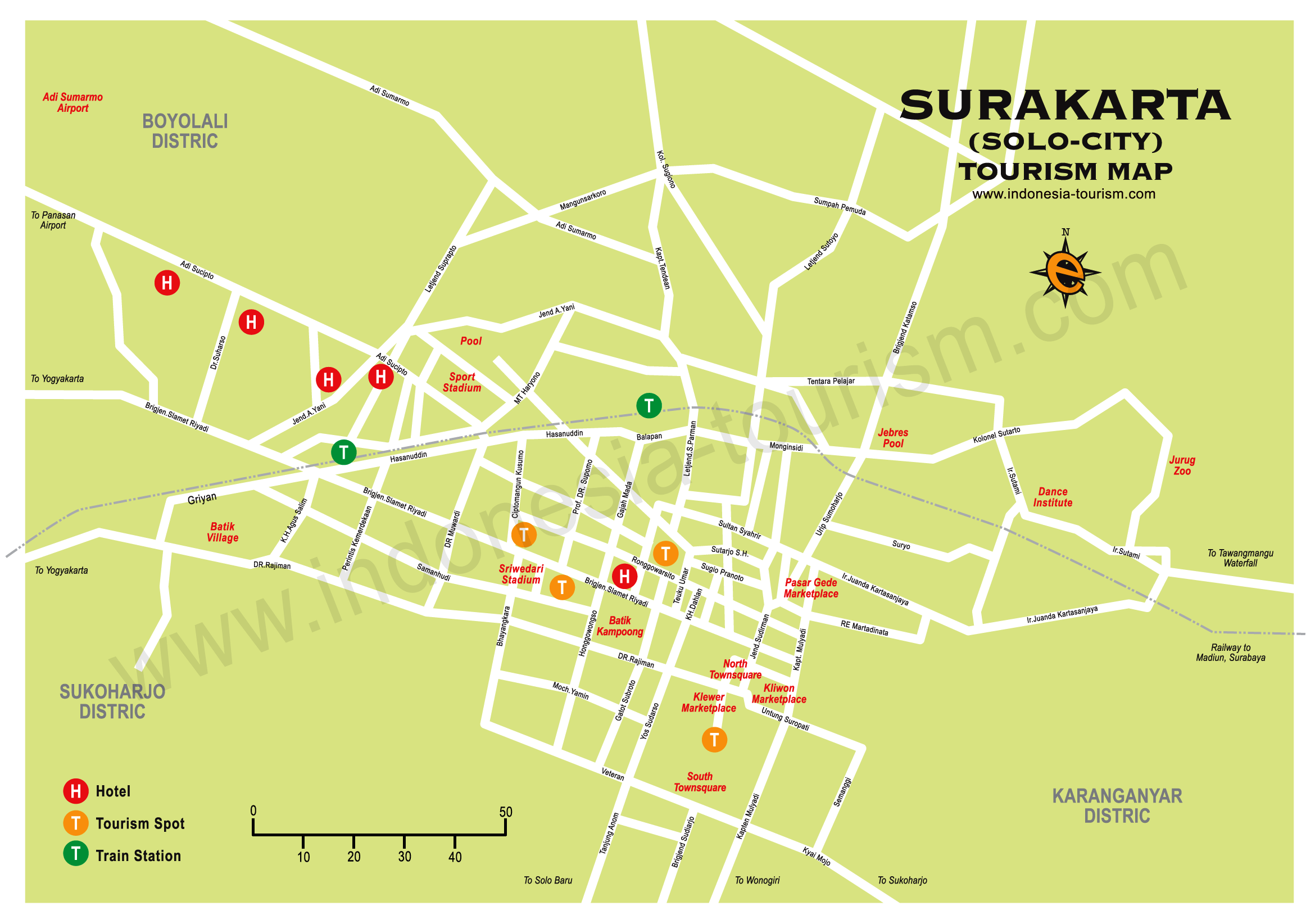
Map And Contact Information


Information Contact
Ambulance: 118.
Police: 110.
Solo Police HQ. Jl. Adisucipto 2, Manahan. Tel.: (62)(271) 712600.
Surakarta Police station. Jalan Slamet Riyadi 376. Tel.: (62)(271) 740683, (62)(271) 713003.
Hospitals with 24 hours emergency room (ER):
RSUD Moewardi. Jl. Kol. Sutarto 132, Jebres. Tel.: (62)(271) 634634.
RS Dr. Oen I. Jl. Brig Katamso No 55. Tel.: (62)(271) 643139, Fax: (62)(271) 642026.
RS Dr. Oen II. Komplek Perum Solo Baru, Tel.: (62)(271) 620220. Fax.: (62)(271) 622555.
RS Kasih Ibu. Jl. Slamet Riyadi no, 354. Tel.: (62)(271) 714422, Fax: (62)(271) 717722.
RS Panti Waluyo. Jl A. Yani No. 1. Tel.: (62)(271) 712077.
RS Brayat Minulyo, Jl Dr Setiabudi 106, Solo 57139. Tel.: (62)(271) 716646, Fax: (62)(271) 727309.
»»  READMORE...

Get Out

Yogyakarta is a more tourist city located close to Solo. The easiest is by car, or charter a taxi (approx. 30 min). Taking the train can also be an option, Prambanan Express (Prameks) leaves frequently during the day (usually catering for the commuter workers) from Solo Balapan and Purwosari Station. Ticket costs Rp. 7500 ($ 0.8) one way. Train ride is about one hour and the last stop will be Tugu Station in Yogyakarta right in the middle of Malioboro.

Borobudur, the largest Buddhist structure in the world, can be seen from Solo, but it would be better to visit from Yogyakarta.

Prambanan temples are a large set of Hindu temples located 50km away. It is easy to stop off at the temples on the way to Yogya.and service to Prambanan just only rp 5,000 if using local bus to yogyakarta from Terminal Tirtonadi.

Mount Merapi, an active volcano looming over the city
»»  READMORE...

Follow Us

Your Shout


ShoutMix chat widget

  © Blogger template 'Ultimatum' by Ourblogtemplates.com 2010

Back to TOP